Industry Background: Digital Wave Reshapes Food Packaging Export Market
In recent years, the global food packaging industry has been undergoing unprecedented digital transformation. From the EU General Food Law to the US Food Safety Modernization Act (FSMA), and Chinas export food compliance requirements, smart traceability systems have evolved from a "nice-to-have" to an absolute necessity. For food packaging exporters, speed of digital transformation directly determines competitive advantage in the international arena.
Core Value of Smart Traceability Systems
Smart traceability is far more than labels and scanners. It is a complete data pipeline covering raw material procurement, production processing, warehousing and logistics, and end-user sales. Its core value lies in three areas:
- Compliance Assurance: Meets mandatory traceability requirements from importing countries, effectively mitigating trade risks;
- Brand Credibility: Transparent supply chains build trust among overseas buyers and consumers;
- Efficiency Gains: When anomalies occur, the exact problem point can be identified rapidly, confining recalls to the smallest possible unit.
Technical Architecture: From Barcodes to Blockchain
Current mainstream traceability technology follows three tiers:
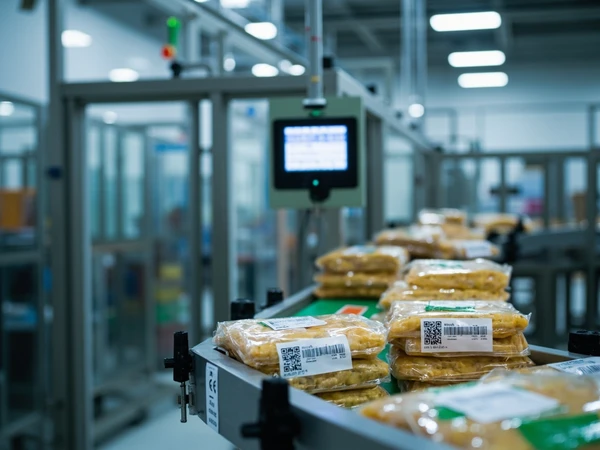
Tier 1: Foundational Digitalization — Using barcodes (EAN-128) and QR codes to record batch information, integrated with ERP/MES systems for internal data connectivity. This is where most companies stand today.
Tier 2: Interoperability — Deploying IoT sensors to capture real-time environmental data (temperature, humidity, pressure) and exchanging information with supply chain partners via cloud platforms. Companies exporting to the EU must pay particular attention to data interoperability requirements under EN ISO 22000.
Tier 3: Trusted Traceability — Embedding blockchain at critical nodes to anchor core data on-chain with full immutability. This tier is currently leading in high-sensitivity categories such as premium infant formula and pet food.
Recommended Implementation Roadmap for Exporters
Not every company needs to leap directly to Tier 3. A staged approach is recommended:
- Phase 1 (Months 1-3): Map out existing supply chain data, identify traceability gaps, and prioritize implementing "one item, one code" at the labeling level;
- Phase 2 (Months 3-6): Align with customer data exchange standards (such as GS1) and establish direct data connectivity with overseas buyers systems;
- Phase 3 (Months 6-12): Introduce third-party audits and certifications based on target market compliance requirements, and progressively advance toward trusted traceability.
Common Challenges and Countermeasures
Three challenges most frequently arise during implementation:
Data Silos: Production, warehouse, and sales systems operate in isolation with inconsistent data formats. The recommendation is to define a unified data dictionary from the outset and prioritize resolving uniqueness issues in batch master data.
Supply Chain Collaboration Gap: Upstream suppliers, especially small and medium-sized material vendors, show low willingness to cooperate. Prioritizing pilot programs with core material suppliers creates a demonstration effect across the broader supply network.
High Certification Costs: International certifications (such as SQF, BRCGS) have long cycles and significant fees. A practical approach is to first meet customer audit requirements, then gradually align with international standards.
Baodafor Digital Practice
As a food packaging manufacturer, Baodafor recognizes that packaging traceability is just as critical as content traceability. When designing product traceability labels for customers, we support GS1 standard data formats and can integrate with major traceability platform APIs. For customers requiring blockchain data anchoring, we offer customized data on-chain solutions, enabling full-chain trusted traceability from packaging to end consumer.
Conclusion
Digital transformation is not a destination but a means of building competitive advantage. Food packaging exporters should ground their approach in actual business needs, select the appropriate traceability technology pathway, and find the optimal balance between compliance and efficiency. Looking ahead, as AI technology deepens its application across supply chains, smart traceability systems will take on expanded roles in risk prediction and decision support — early movers will gain the first-mover advantage.
This article is original content from Baodafor. Reproduction must include attribution.