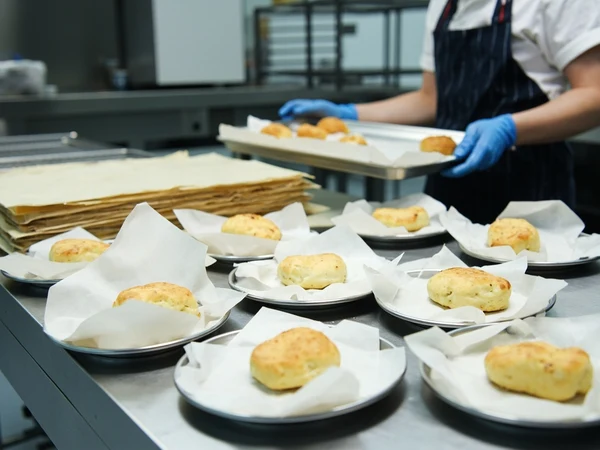
Whether baking paper performs well rarely depends on how thick it feels in the hand. It depends on three parameters: grammage, the coating method, and the temperature range. When those three do not match the baking category, the problems are easy to recognize on the line. Oil seeps through to the back of the tray, cookie bases wrinkle and stick, and batter spreads unevenly in the oven. Reading these three parameters explains most of the complaints that come back about baking paper.
The first parameter is grammage, the mass of paper per square meter, which determines stiffness and how much weight the sheet can support during baking. The common commercial range runs from 30 g/m2 to 60 g/m2. Below 30 g/m2 the sheet wrinkles easily and cannot hold a shaped batter. The 40 g/m2 to 50 g/m2 range suits standard cookies, cupcakes, and general biscuit work. Above 60 g/m2 the sheet is used for high-fat pastries and heavy-oil cakes that depend on support from the mould, because thicker paper deforms less during the bake and curls or collapses far less often.
The second parameter is the coating method, which determines how well the paper resists grease and moisture. Three approaches are common in practice. Uncoated base paper is the cheapest but offers limited barrier performance. Polyethylene-coated paper has a higher temperature ceiling and lower cost, and remains the most widely used solution in commercial baking. Silicone-coated paper delivers the best release and is close to non-stick after baking, which makes it the natural choice for laminated puff pastry and tart shells that contact the paper directly. Silicone coating, however, normally carries a lower maximum temperature than pure polyethylene coating, so temperature and release performance have to be considered together rather than one at a time. Both the base paper and the coating layer need to meet the applicable requirements for food contact materials.
The third parameter is the temperature range, which decides what a sheet can actually go into. Standard baking commonly runs around 180 degrees Celsius, while some applications push above 220 degrees Celsius, and the stated limits differ considerably between product grades. Confirm that the stated range covers the real oven temperature, and note that a temperature rating normally applies to the baking stage only, not to direct flame or microwave use.
In practice, selection is a matter of routing by fat content and contact. Scenarios that need higher heat tolerance and some structural support are better served by aluminum foil. Laminated pastry that touches the sheet directly works more easily with silicone-coated baking paper. For standard cookies and cakes, a conventionally coated paper at an ordinary grammage balances cost and performance well enough.
Size and supply format affect line efficiency as much as the paper itself. Pre-cut sheets matched to the tray remove manual trimming and offcuts, and roll widths matched to line speed reduce changeover downtime. When Baodafor takes on packaging requirements from baking customers, the recommendation covers grammage and coating combinations against the customer's product category, oven temperature, and line takt, together with both pre-cut sheet and roll formats, so the performance of the paper actually translates into output on the production line.