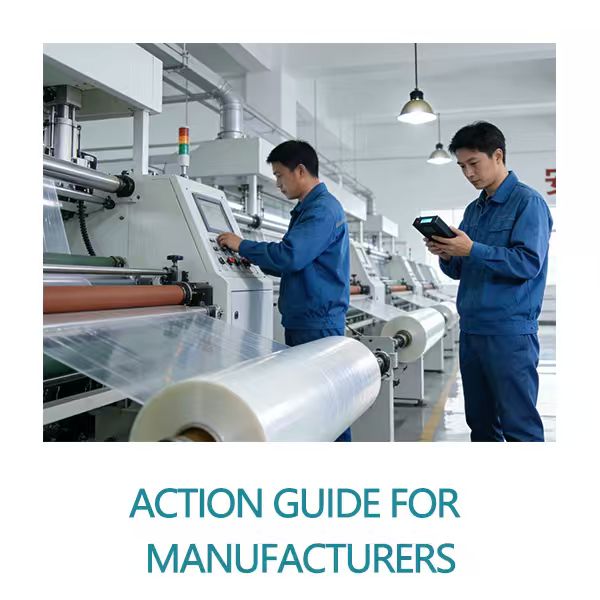
Slitting and bag making are the two steps in food packaging production that depend most on detail. Once the condition of a blade drifts out of spec, the visible result is not abstract: film edges pick up burrs and scratches, roll width deviates from the confirmed dimension, and heat-seal strength fluctuates batch to batch. Every one of those changes eventually shows up in the customer's finished pack. Managing blades and tooling as a daily routine has therefore become a practical part of how a packaging converter protects delivery reliability.
First, it helps to see how wear travels into the product. As a slitting blade dulls, it tends to pull film toward the cut edge and leave a burr behind. Uneven pressure across sealing and cutting jaws produces virtual edges or locally lifted seals. Knocks during reel changes and machine adjustments leave pressure marks on the film surface. Food contact materials are especially sensitive to these defects, which is why batch-to-batch appearance consistency has become a frequent checkpoint during incoming inspection at customers.
Second, the routine works best when it is split into three clear nodes. At issue and storage, tooling is kept in a dedicated cabinet under fixed-position management: blades are cleaned after use, protected against rust and moisture, and stored so that edges never meet hard surfaces. Before a blade goes back on the machine, it goes through a visual check and a trial cut, confirming that the clamp is tight, the edge has no chips, and the assembly is free of loose material. Third, replacement is driven by accumulated running length rather than by habit. When the scheduled interval is reached, or when output quality shifts early, the blade is changed immediately, and every replacement and edge condition is written down.
Third, a blade change must be followed by a reset and a first-article confirmation. The slitting width and web tension are recalibrated, machine debris is cleared, and a trial roll is cut. Cut dimensions, edge burrs and seal strength are checked on that trial roll before the run moves into mass production. If the first article is not released and the record is not closed, a routine tool change simply becomes a new source of variation.
Fourth, this discipline pays off for customers in concrete ways. Repeated runs of the same specification land closer to each other in appearance and dimension, sealing performance stays more consistent, and returns and complaints drop accordingly. Complete change records also support batch traceability and compliance checks for food contact materials.
Finally, three points are worth keeping in mind when evaluating packaging suppliers. Ask whether the supplier maintains change and calibration records for blades and tooling. Look at consistency in cut dimensions and appearance across batches, not merely whether a single batch passed. And ask how seal strength is confirmed and against what criteria, so that the standard does not shift from batch to batch.
Baodafor continues to refine the fine-grained controls across its production process, so that every roll of food grade packaging material leaves the factory performing consistently.