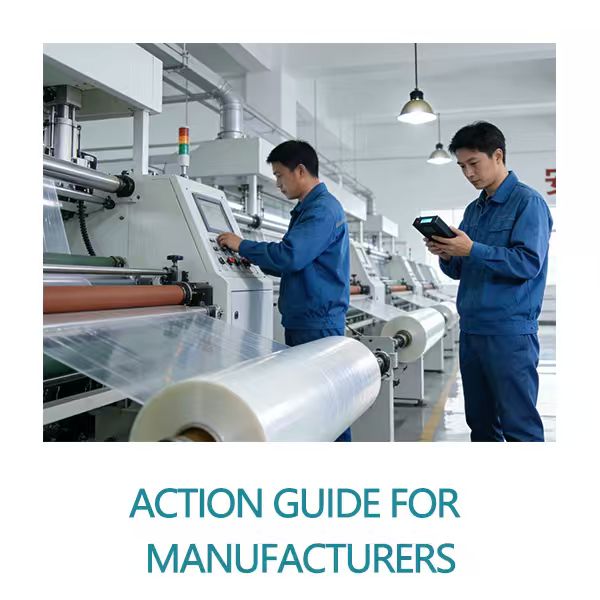
Baodafor Introduces First-Article Confirmation and Line Release to Move the Quality Gate Ahead of Batch Production
In food packaging production, what really sends a whole batch back to a customer is rarely a single isolated defect. It is one small mistake repeated across thousands of rolls. Changing a size and running the line without confirming the first output, adjusting a process parameter on the spot, or switching to a new raw material batch while still using yesterday's approved sample — each of these turns a minor deviation into a batch-level quality problem. At Baodafor, first-article confirmation is a mandatory step before every startup, changeover and restart: before mass production starts, the first piece is used to confirm dimensions, process settings and appearance.
The Four Actions of First-Article Confirmation
First, sampling. After startup or a changeover, the operator on shift takes several consecutive first samples while the line is running in a stable state, not the transition material from the very first seconds.
Second, comparison. The samples are checked item by item against the confirmed specification file and the sealed reference sample: cling film is verified for width, basis weight and clarity after stretching, ziplock bags for size, sealing flatness and slider performance, while aluminum foil and baking paper are checked for basis weight, coating uniformity and printed artwork position.
Third, judgement. Quality control or process engineers give the verdict — "release" or "adjust and re-run" — against the agreed criteria. The operator cannot make this call alone.
Fourth, documentation. The record captures who confirmed, when, which batch, the actual process settings and where the retained sample is stored. Any adjustment made during the check is recorded as well, so a later investigation has something to work from.
Six Situations That Require a New First-Article Confirmation
Confirmation is not a one-time action at startup. Six situations require fresh samples: a changeover or a switch to a different product specification; a new raw material batch or supplier; after equipment repair, adjustment or the replacement of blades and tooling; when restarting after an abnormality stoppage; at shift handover or after a long shutdown; and after any temporary change to temperature, speed, tension or sealing parameters. Posting this "re-confirm list" at the workstation works far better than repeating it verbally.
How It Connects with the Rest of the Plant
First-article confirmation is not a standalone action. It links into a single chain with the specification selection system, the quick changeover mechanism, the real-time line abnormality response, the periodic calibration of measuring instruments, blade and tooling management, and the retain-sample and shelf-life validation system. The selection system answers "what specification to run", the changeover mechanism answers "how to switch faster", abnormality response answers "what to do when something goes wrong" — and first-article confirmation answers the most upstream question: whether the very first piece coming off the line after this startup is actually right.
What It Means for Customers
First-article confirmation moves the quality risk from "inspection afterwards" to "the moment of startup", so customers receive more consistent batches. For Baodafor itself, it also reduces bulk rework, repeated returns and the communication cost that follows them. In an industry like food packaging, with long product lines, many specifications and widely varying order quantities, getting the first piece right is usually more economical than inspecting every piece that comes after it.