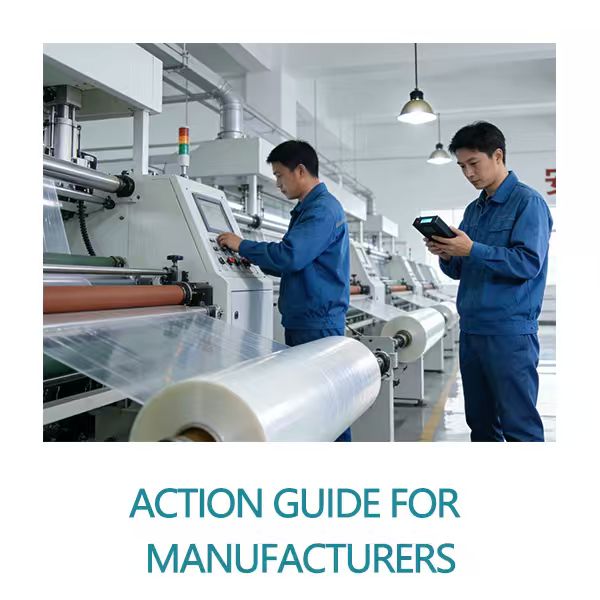
Baodafor Standardizes Critical Spare Parts and Wear-Part Management: A Tiered List and a Shared Spare Pool Keep Downtime Controllable on Packaging Lines
1. The real bottleneck is rarely the breakdown itself, it is the wait for the part
Line stoppages on food packaging equipment are routinely filed as "equipment failure". Break each one down a layer further and the capacity that actually disappears is often not the repair work itself but the waiting: waiting for a heating tube to arrive, waiting for a thermocouple to be replaced, waiting for a cutter shaft bearing, a conveyor belt splice, an extruder screen. None of these parts is expensive or large. What makes them difficult is that they are not on the shelf, not in a shared pool, or sitting in the warehouse while nobody knows which workstation holds them.
Baodafor runs lines for ziplock bags, PE cling wrap, aluminum foil and baking paper. With many specifications and frequent changeovers, the same machine carries different jobs under different orders, and the wear pattern is not identical across them: the heat sealing assembly of a bag making machine takes more thermal shock during frequent changeovers, the cutter shaft and bearings of a slitting line wear faster under continuous load, and the screen and heater band of an extruder are tied directly to the material formulation. Managing spare parts by "stocking a bit of everything" therefore does not work. It needs a list, a tiering system and data.
Through 2026 we have separated critical spare parts and wear parts from ordinary consumables and manage them on their own. The goal is simple: to turn "how long do we wait after a breakdown" from an uncertain, reactive state into one that can be planned and bought ahead of time.
2. Tier the parts: three categories, three stocking policies
Category one, critical spare parts. When these fail the line simply cannot continue, yet they have long lead times and low interchangeability. Typical examples are the sealing heater tube and thermocouple of a bag making machine, the cutter shaft bearings of a slitting line, and the screen and heater band of an extruder. The policy is a defined safety stock: the reorder point is tied to stock on hand plus goods in transit, and replenishment is triggered when the lead time is reached rather than when someone notices the bin is empty.
Category two, frequently replaced wear parts. These are replaced often, cost little individually, and are easy to replace, such as pneumatic fittings, sealing rings, drive belts and heating wires. The policy is central storage and replenishment based on consumption, with stocking levels driven by how fast a part actually goes out rather than by how much it costs.
Category three, standard and substitutable parts. Bearings, fasteners and belts of common specification are readily available, so the policy is to avoid tying up working capital, keep only a small emergency quantity and place the purchases into planned maintenance windows.
Why the tiering matters is where the money goes. Without tiering, the common approach is to stock a little of everything, and the result is that the heating tube, which really does stop a whole line, ends up short while a large number of low-value parts occupy shelf space and cash.
3. A shared spare pool: every line does not need its own set
In a plant with several categories and several lines, a second waste is easy to underestimate: stocking a separate set for every line. The same heating tube, bearing or pneumatic fitting is used on more than one line, and stocking them separately ties up money while spreading them out so thinly that the real remaining quantity is hard to see.
We consolidate these parts into a shared spare pool, where the storekeeper registers model, batch, arrival date and remaining life in one register, and lines draw against it as needed. The issue records double as consumption data: which models leave each month, which spares have barely moved for several months, and which ones have been drawn twice within three months. That usually points to a model change or a design improvement rather than to simply ordering the same part again.
Sharing also pays off on the supply side. Short-lead standard parts no longer need to be bought line by line; the orders can be combined for better pricing and steadier supply. Meanwhile the handful of genuinely critical parts can sit at a safety level higher than any single line would justify on its own, so the total coverage ends up stronger than fragmented stocking.
4. Use issue data to correct replacement intervals and let stocking follow real consumption
The part of spare parts management that most often goes wrong is the replacement interval. Stocking to the interval written in the equipment manual frequently disagrees with actual consumption, because the manual assumes full load and a single specification, while the shop floor alternates between orders, runs small batches and changes over frequently.
Our approach is to review actual consumption of critical parts each quarter from the issue records and to read it together with the inspection records of preventive maintenance. When an inspection shows that a component is approaching its replacement point, it triggers the purchase action instead of waiting for the failure. The issue data also corrects maintenance planning in the other direction: if the real life of a part is clearly longer than expected, it can move from scheduled replacement to condition-based replacement, avoiding unnecessary stoppages and teardown.
It is worth separating two things that look similar. Tooling and blade management is about machining accuracy and product appearance; spare parts are about equipment availability. Both rely on data rather than impressions, but the lists, intervals and stocking policies are kept apart.
5. Suppliers and lead times: multiple sources for critical parts, local sourcing for standard ones
The other half of spare parts management sits on the supply side. The worst case for a critical part is having only one source, because a lead time swing or a transport problem leaves the line waiting with nothing to do.
We keep two or more sources for critical parts, and any alternative model is validated in advance: dimensions, material, temperature resistance and sealing performance must meet the actual working conditions, and after fitting, a first-article confirmation has to be repeated and accepted before the alternative is released for regular use. Trial fitting while the machine is already down is exactly what we want to avoid. Standard parts are sourced locally instead, because a short lead time is itself an inventory strategy, and the working capital saved can be traded for faster response.
In peak periods and when orders concentrate, we also pull part of the critical stock forward against the sales delivery plan, so that parts and orders do not collide at the same point on the timeline when lead times are tightest.
6. Closing the loop after a replacement: first-article confirmation tied to the spare parts register
Replacing a part does not close the problem. A heating tube that is similar in model but different in performance may shift the sealing temperature window and change sealing strength slightly; a new cutter shaft bearing may change how stable the slit dimension is compared with before. Such deviations do not show up as failures. They travel to the finished product as small drift in appearance or strength indicators.
We therefore tie a replacement to line release and first-article confirmation: after the change the machine re-enters the startup confirmation state, and mass production starts only once the first article passes. The replacement is then written into the spare parts register together with the equipment ID and batch number. This serves two purposes. It keeps the deviation out of the product, and when a customer reports an unusual indicator in one batch, the affected range can be traced quickly along the chain of replacement record, first-article confirmation and batch, instead of putting the entire order under investigation.
The register doubles as an equipment history: which machine had which part replaced, how long it lasted before failing again, the brand and batch of the part. Read back after six months, this data naturally reveals which machines and which components are the real weak points, which informs the next round of equipment selection and line layout.
7. What this means for food packaging customers
Spare parts management does not print onto the product, but it determines how dependable the delivery is. For customers it shows up in very concrete situations: a batch of ziplock bags does not slip because one heating tube was late; a changeover on the PE cling wrap line does not stall halfway while waiting for a sealing ring; orders for baking paper and aluminum foil progress on the schedule that was committed.
The more practical effect is stability. When a replacement no longer introduces drift, sealing strength, thickness deviation and edge burrs stay within a narrower band from batch to batch, so the result of one incoming inspection can be applied to later batches, and the customer's incoming acceptance workload eases with it.
Baodafor runs flexible production across multiple categories, small batches and many specifications, with varied equipment and frequent changeovers. This system of spare parts tiering and a shared pool is how we keep the waiting time for every critical part inside the plan instead of leaving it to chance.