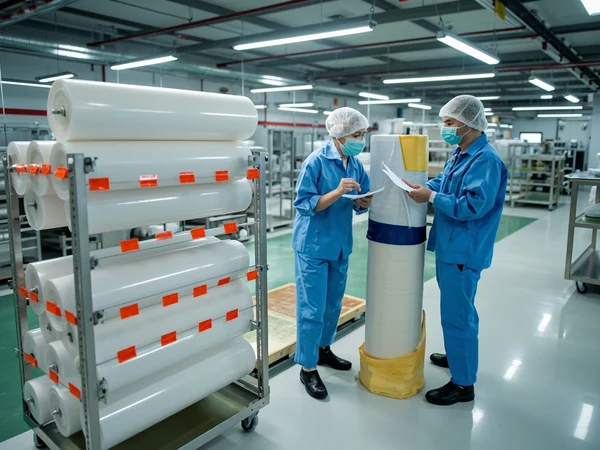
Baodafor Builds a Quarantine and Disposal System for Nonconforming Material: Every Rejected Film Roll Has a Clear Basis and a Defined Fate
1. Quarantine comes before judgment
In food packaging production, when a roll of raw material or a carton of finished product is judged nonconforming, the first action is not to investigate why it failed. The first action is to take it out of the world of good product.
The reason is straightforward: once food contact material mixes into a good batch and reaches the customer, the consequence cannot be undone. What the customer receives may be a carton of ziplock bags that look perfectly normal, only for the seal to fail in cold chain or long-haul transport after the bags are filled. It may be a batch of PE cling wrap with transparency and haze outside specification, where the customer blames their own product for discolouring. It may be a roll of aluminum foil laminate with marginal seal strength that passes every visual check at dispatch and then simply will not hold a seal when the customer runs the filling machine. All three share one characteristic: at the moment they leave the factory, they are indistinguishable from good product. Only the test data tells them apart.
Quarantine therefore has to satisfy three requirements at the same time. Physically, the material is stored on its own, never sharing a rack or a returnable bin with good product. Visually, its status is unmistakable, so that anyone standing next to that roll knows it must not go on a machine. And on paper, the whole episode is traceable: who made the call, when, on what evidence, and where the material ended up afterwards.
2. How quarantine works: zoning, marking and a written record
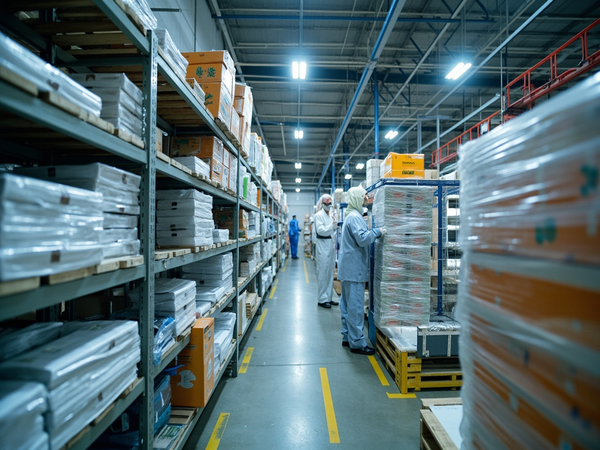
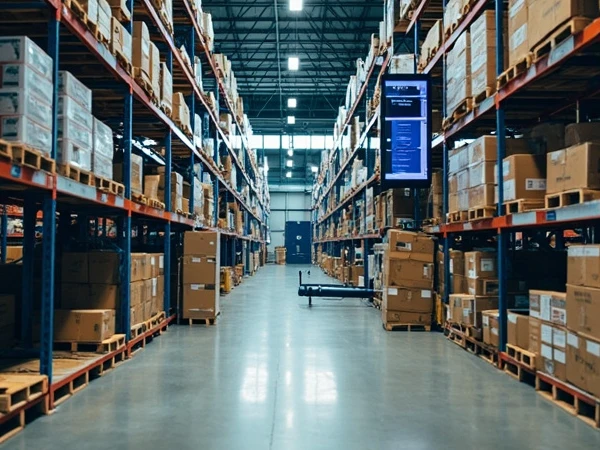
Zoning. The workshop is divided into a pending-judgment area, a nonconforming area and the released-goods area, with floor lines and signs making the boundaries obvious and a fixed position for every roll. The pending area holds material for which no conclusion has been reached yet. Once quarantined, it must carry a status tag stating the material description, batch number, roll or carton number, when and where the issue was found, the reason for the judgment, the responsible person and the current status. The nonconforming area is where material that already has a conclusion waits for disposal. Keeping the two apart prevents unjudged material from being handled as if it had already been judged and released.
Marking. Marking is what makes quarantine actually work. An unmarked quarantined roll is the same as no quarantine at all: it looks exactly like normal material, and the operator simply notices that there is one extra roll sitting at the side. The mark has to travel with the material. Rolls are tagged or strapped at the core position, and bagged product is marked on every pack inside the carton rather than only on the outside of the box, because the moment the carton is opened, an external label stops protecting anything.
The record. Every quarantine event is entered in a log: quarantine note number, material batch, quantity, evidence used, review conclusion, disposal route, who executed the disposal, completion time and the related order. This log earns its keep in two situations. First, when a customer raises a complaint or conducts an export audit, the complete answer to "why was this batch not released" can be produced in minutes. Second, when the same kind of problem appears again, the log shows how it was judged and disposed of last time, which stops one recurring issue from being handled to two different standards.
3. Judgment criteria: not "it looks good enough"
After quarantine comes judgment, and the basis for judgment is data and specification, not visual impression. At Baodafor the main reference points are the following.
Incoming film rolls: surface cleanliness and gels, edge neatness, number of cores and splices per roll, measured thickness and grammage against the specification range, and whether the batch test report and accompanying documents are complete.
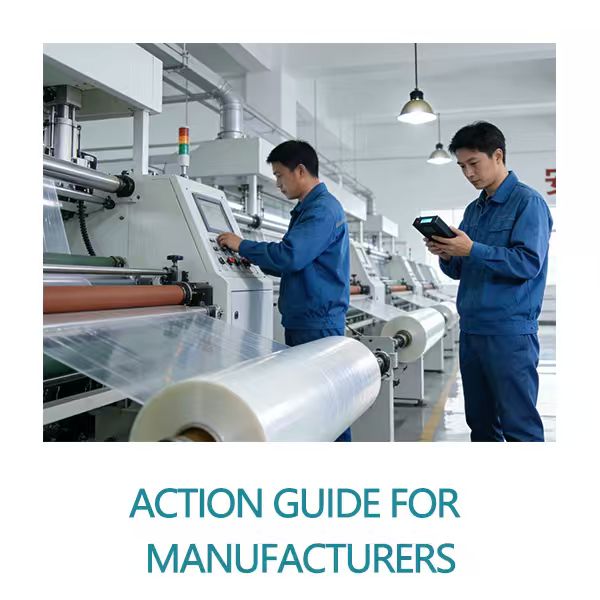
Slitting and bag making: deviation in cut dimensions, bag length and seal position, heat seal strength and peel test results, whether the seal area shows premature sealing or incomplete sealing, and whether bag mouths are damaged.
Lamination and coating: whether the layers have delaminated, peel strength, uniformity of the surface treatment on the aluminum foil, and whether the compliance documentation for adhesives and coatings is on file.
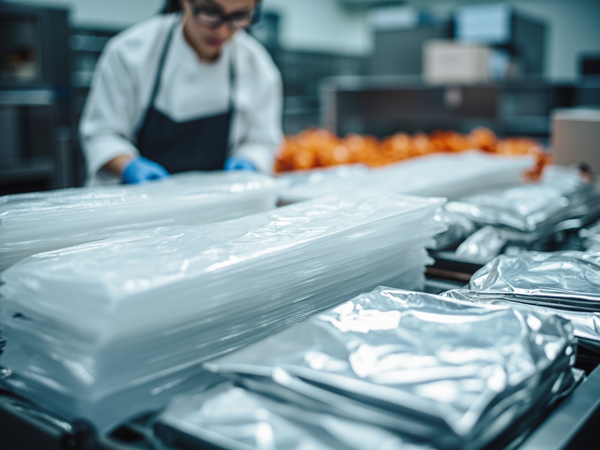
Finished product and appearance: transparency and haze, seal flatness, print registration, and whether batch identification and date coding are correct.
One principle deserves emphasis. Food contact material has a specific cost asymmetry: the cost of judging something nonconforming is far lower than the cost of wrongly judging it good. Downgrading one roll for non-food-contact use costs little. Letting one unjudged roll through to the customer costs the customer's trust in the whole batch, and with it every order that could have followed. That asymmetry is the reason the quarantine system exists at all, and the reason it is more than simply moving suspect material to the side of the workshop.
4. Disposition routes: scrap is only one of them
A judgment must be followed by a disposition decision, and the decision normally falls into four categories.
Rework. This route applies when the problem lies in the process rather than in the material. Film that went beyond the cut dimension but is sound in itself can be re-slitted; bags sealed at the wrong heat seal temperature can be re-sealed with corrected parameters. The critical point with rework is confirming that performance is still on specification afterwards. Re-slitted film may land on the right width but with a trimmed edge, and a re-sealed bag may not recover its original peel strength. Both have to be measured rather than assumed on the grounds that sealing it again cannot hurt.
Downgrading. Material with minor deviations can sometimes be put to a different, clearly limited use: baking paper with slight surface blemishes can be reassigned as an interleaving sheet, and film with a small dimensional deviation can become a packaging liner that does not touch the food. A downgrade must be recorded in writing, stating what the material may be used for and what it must never be used for, so that downgraded material does not travel through the workshop having forgotten its own restriction.
Return and claims. When an incoming material issue belongs to the supplier, the quarantine record is the evidence for the claim. Batch number, roll number, photographs taken at quarantine, test data and the written conclusion together make the discussion between the two sides considerably shorter.
Scrap. Material that can neither be reworked nor downgraded has to be scrapped. Scrapping is not simply disposal either: food contact material needs a verifiable disposal method, so that waste cannot re-enter production in any form.
There is also a fifth outcome, conditional release. Material may be released with conditions where the customer, the intended use and the acceptable risk are all explicit. Such a decision must be made by an authorised person and supported by a written record; it cannot be made verbally on the shop floor by an operator.
5. How it connects to batch traceability, retain samples and complaints
A quarantine system only earns its value when it is genuinely connected to the rest of the process.
Batch traceability. The batch numbers in the quarantine log must map onto production batch numbers and customer order numbers. When a customer reports a seal problem on a batch of ziplock bags, it should be possible to look back and see whether a similar issue was quarantined at the time, what the conclusion was, and whether other customers were notified. The quarantine record and the complaint process then form two matching lines: one that stops the problem where it arises, and one that traces the affected scope after the problem surfaces.
Retain samples. Retain samples exist to verify how a batch performs across its shelf life, while a quarantined sample is physical evidence of a specific problem. The two are stored separately, so that the problem sample keeps its review value after the retain period has passed.
Improvement. When the same problem keeps recurring, the judgment criteria themselves should be reviewed: is the standard set too tight, or is process variation running outside the standard? Grouping the reasons behind repeated quarantines usually explains the root cause far better than handling each incident on its own.
6. What it means for food contact safety and customer audits
There is one shared understanding in food contact material production: material that may come into contact with food has to be judged more strictly than other material. The quarantine system turns that strictness into shop floor action. Every quarantine has a basis, every release has a signature, and every disposition has a destination.
For customers, the practical value of the system shows up as delivery certainty. A supplier that can answer clearly which batches were quarantined, why, how they were handled and which orders were affected saves its customers a great deal of time in auditing and traceability work. This matters most for export orders, where many overseas customers look beyond incoming sampling and review the supplier's process records, and where the handling of nonconforming material is routinely one of the items checked.
For Baodafor itself, with ziplock bags, PE cling wrap, aluminum foil and baking paper running in parallel across many specifications and very different batch sizes, the quarantine system keeps different specifications from contaminating each other and allows the data behind every dispatched batch to be traced back to a specific incoming roll number and set of process conditions. It is a quality asset that is accumulated slowly, one quarantined roll at a time.