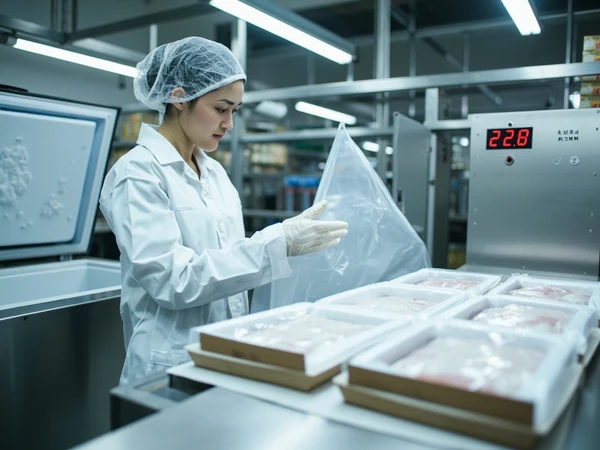
Freezing is the most demanding environment a PE cling film ever has to work in. Once the temperature drops to -18°C or below, the motion of PE polymer chains slows down sharply and the film loses toughness. The effect is easy to see on the packing line: corners of a wrapped tray develop tiny splits, film pulled straight off the roll tears more easily, and condensation on the chilled film surface makes it settle unevenly on rigid containers, leaving air gaps along the rim.
For buyers and packing-room operators, three measurable indicators decide whether a cling film is suitable for frozen storage.
First, low-temperature stretch performance. The film should keep enough elongation at -18°C to wrap a tray or tub without splitting, and it should spring back instead of staying permanently deformed. A film that is flexible at room temperature but brittle when chilled will fail on the very first cold-storage shift.
Second, low-temperature impact and puncture resistance. Frozen goods are stacked, transported and occasionally dropped. The film has to survive that handling together with the container, because a crack that starts at a corner quickly becomes a leak path that lets cold air and moisture in.
Third, haze and light transmission. Cold cabinets are display cabinets as well: shoppers and kitchen staff need to identify the product inside at a glance. Film that turns noticeably hazy in the cold makes the packaged food look dull and weakens shelf presentation.
Three practical tips for packing rooms. First, always check the stated temperature range on the specification sheet. For frozen storage choose food-grade PE cling film that explicitly covers -18°C or -25°C and complies with applicable standards such as GB/T 8808, and ask the supplier for the matching test report. Second, do not over-stretch the film while wrapping. Pre-stretching thins the web, and a thinned web is the first thing to crack inside a cold cabinet. Third, let the film return to room temperature before peeling it off a frozen container, so the edge does not tear along a cold-brittle line.
For long-term cold storage with heavy stacking, a ziplock bag or a foil-based laminate is usually the better choice on strength and barrier performance. PE cling film is at its best for daily portioning, covering and short-term freezing.
At Baodafor, low-temperature stretch, low-temperature impact and haze change are treated as routine verification points in cling film production. Every roll is checked against the cold-chain conditions it is actually going to meet, so the material behaves consistently on the shelf instead of only in the laboratory.