Food Contact Packaging Goes Additive-Free: How Low-Migration PE Cling Wrap and Ziplock Bags Meet Retailer and Export Audit Requirements
1. After "is it food grade", customers start asking for numbers
For a long time the first question in almost any food packaging purchase was simply "is it food grade?". That question still matters, but on the audit checklists of large retail private-label programmes, chain restaurant groups and export customers, a second layer of questions now follows: what is the total migration? Is there a specific migration limit for each substance? Which additives are used? Are any phthalate plasticisers present? How is the level of slip and antiblock additive controlled?
Put plainly, the way packaging materials are reviewed is changing from "checking one certificate" to "checking a set of verifiable data".
2. What migration and "additives" actually mean
Total migration. This is the total amount of migratable substances transferred from the packaging into food. Plastic food contact materials carry a general requirement: total migration must not exceed 10 mg/dm². That is a baseline, and it measures whether the overall migration level is under control rather than whether any single substance is over its limit.
Specific migration. A limit is set for individual substances, which are then tested separately, for example heavy metals, residual monomers or plasticiser compounds. A satisfactory total migration result does not automatically settle the compliance conclusion for every substance, so the two sets of tests have to be carried out and read separately.
The additive positive list. Which processing aids may be used in packaging, and in what quantities, is set out in an authorised list within the applicable standards. Compliance does not mean "add nothing at all"; it means every substance that is added becomes a controlled, bounded and traceable variable with a documented basis.
Why "plasticiser-free" comes up so often. Phthalate plasticisers are the most typical compliance-sensitive substances in flexible packaging, but it is worth being precise: polyethylene (PE) does not need plasticisers at a structural level to be flexible. What reviewers actually watch is the processing aids added so PE film can be slippery, openable and anti-static, plus the adhesives, coatings and inks in composite structures. The migration levels and odour behaviour of those substances are where the "additive-free" discussion really lands.
3. Three specific points on PE cling wrap and ziplock bags
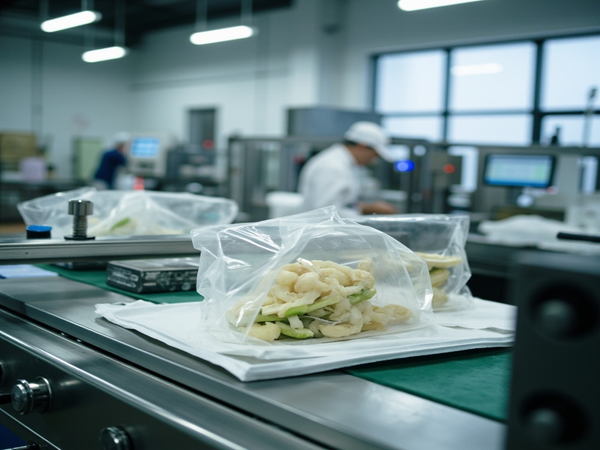
Source and grade of the base resin. Film for food contact uses food grade polyethylene resin, and the grade, supplier and production batch must be traceable. Recycled material intended for food contact is tightly restricted and cannot be mixed with general recycling stream. Retail and export customers increasingly ask for a compliance declaration on the resin itself, not only a test report on the finished product, because a passing finished product cannot prove the compliance of every incoming roll.
Balancing slip and opening additives. PE surfaces are inherently "slippery-resistant" in the sense that film stacks would clump into a single block, so slip agents and antiblock additives are used to improve converting, bagging and opening. More additive means better slip, but it also brings two consequences: migration to the film surface that affects appearance and odour, and higher migration under heat or long contact conditions. The production target is the band that is just sufficient, not the maximum possible.
Ink and composite structures. Ink on food packaging has to meet the specific requirements for food contact inks, and areas in direct contact with food are normally left unprinted. Adhesive and coating layers in a composite body migrate very differently from one another, and the presence of a barrier layer (PA, EVOH, PET) changes the overall migration path. The more complex the structure, the more combinations of operating conditions have to be validated. In a ziplock bag, the consistency of heat-seal and lamination thickness also affects final migration and odour results.
4. The paper and foil side is changing too
For baking paper, the review focuses on the raw material and the surface treatment: food contact paper should not contain fluorescent brighteners, the silicone or coating used for oil and release resistance needs a clear compliance basis and a controlled dosage, and the area in direct contact with the bake is normally kept free of printing. Baked goods with high oil and sugar demand more from the base paper against grease penetration. For aluminium foil, the focus is the coating system and its compatibility with the contents: coatings must meet food contact coating requirements, compatibility with aluminium has to be assessed separately for acidic or high-salt contents, and steaming and baking applications add thermal conductivity and temperature resistance considerations.
Set these three material families side by side and it becomes clear that "additive-free" is not an attribute of a single product; it is a compliance structure that the whole supply chain carries together.
5. What a packaging factory has to produce for a customer audit
When a buyer takes material review seriously, what the supplier needs to have ready is actually quite concrete:
— Documentation on the raw material side: resin grade and food grade evidence, the list of additives in use, and the type and dosage of slip and antiblock agents;
— Data on the testing side: total migration and specific migration reports, heavy metals, sensory and odour evaluation, and the test conditions matched to real use conditions (contact temperature, contact duration, type of food simulant);
— Traceability on the production side: batch definition rules, retained samples and their retention period, and records of key process parameters;
— Change management: replacing a resin supplier, adjusting an additive recipe, changing ink or switching a composite structure should be notified to the customer in advance, followed by renewed validation and, where necessary, re-testing;
— Labelling: food contact materials and articles should carry material and use-condition information so that downstream users apply them in the right context.
6. What this shift means for packaging manufacturers
For Baodafor, the competition around ziplock bags and PE cling wrap is no longer only about price, capacity and lead time. A retail private-label or export customer audit is effectively a filter for suppliers that can reliably deliver verifiable material data: traceable raw material sources, reproducible test reports, manageable formula changes. Those capabilities rarely show up during the sampling stage, yet at volume production and audit time they decide whether an order continues.
At the same time, the push towards additive-free materials opens room for material innovation: formulations that depend less on processing aids, slip and opening achieved through the base resin and the process itself, and structural design replacing part of the chemical approach. These directions demand more from formulation capability and process control, and they form the basis for the next round of differentiation.
The logic for aluminium foil and baking paper is exactly the same: moving from "it passes a food grade test" to "every layer of the material can be explained".