Setting the Heat-Seal Window for Ziplock Bags: How Temperature, Pressure and Time Balance Seal Strength Against Premature Sealing
1. The same bag can behave differently on a different sealing machine
A familiar scenario in the packaging industry: the customer runs the material to the specification Baodafor provided, moves to a different sealing machine, and from then on the bags either will not hold and leak once filled, or seal too early and the mouth area sticks together. It is also common for one batch of material to run smoothly on one customer's line and never settle on another customer's line. This is rarely a sign of unstable bag quality. It reflects the fact that heat sealing is a window, not a point.
The outcome of a heat seal is determined by three variables: temperature, pressure and time. Temperature determines how far the material surface melts, pressure determines the thickness and density of the pressed melt, and time determines the total energy delivered as heat and force. The three can compensate for each other: a lower temperature can be offset with a longer dwell, and a lighter pressure with more time. What really determines how usable a bag is, however, is how wide the range of working combinations can be before something goes wrong, which is what a sealing window means. A wide window keeps the line stable and makes changeovers easy; a narrow one means a small material batch variation or a slight change in machine condition is enough to push the seal outside the acceptable range.
2. The two boundaries of the window: weak seals and premature sealing
The lower boundary is a weak or false seal. The joint looks closed, opens with a light pull, and starts to leak slowly once liquid is packed inside. The awkward part about this defect is that it often passes inspection on the line and only shows up on a shelf or in the customer's hands. The usual causes are insufficient temperature, pressure or time, but they can also come from a material batch with a low melt flow rate, where the same parameters are no longer enough one roll later.
The upper boundary is premature sealing, where the sealing zone bonds nearby material too early, content ends up trapped inside the seal, or the film sticks together while the pack is still being filled. Premature sealing has real consequences: it limits fill volume, disturbs the filling cadence, and on foil laminates it shows up as distorted contents, creased aluminium or even perforation.
Because both boundaries have to be respected, the goal of window management is not to maximize seal strength but to locate the usable range and stay inside it. Pushing strength to the maximum is usually where premature sealing begins.
3. Material-side variables: melt flow, slip additives and gauge
Half of the window width is decided by the equipment and half by the material. The key material indicator is the melt flow rate: too much flow lets the material spread excessively in the sealing zone and raises the risk of melt squeeze-out and a sticky bag mouth, while too little flow demands a higher temperature or a longer dwell to reach a proper bond, which narrows the window in the first place.
Slip and anti-block additives matter just as much. To let the zipper and the bag mouth travel smoothly through the line, a certain amount of opening agent is added to the formulation, but these additives migrate to the surface and change sealing behaviour. Surface deposit shifts the window downward as a whole; uneven deposit makes it fluctuate. The same roll can therefore behave differently early and late in a run, or after different storage conditions.
Gauge and structure have a more direct effect. At the same temperature, pressure and time, a thicker film means a longer heat path and more dwell time to complete the bond. PE ziplock film and foil laminate have different heat-seal layers and grammage, so their windows sit in completely different ranges: foil laminates normally need a higher temperature and tighter temperature control because their tolerance is much smaller.
4. How to qualify a window: find the plateau, do not record a single point
The usual practice is to note down "one set of parameters that works". A single point is the most fragile asset in a process: when the material batch changes, the machine ages a little or the season turns, the line can fall straight back into an unacceptable state. A more reliable method is a stepped qualification.
In practice: hold pressure and time constant, step the temperature up in equal increments, make several samples at each level and test seal strength; then fix the temperature at a mid value and step the pressure, running the same strength tests. Plotting the results as a seal strength curve usually reveals a clear plateau, where strength barely changes with temperature or pressure, with the edges falling away sharply on the weak-seal side or showing sticking and distortion on the premature-seal side. The width of that plateau is the usable process window, and the set point should sit in its middle rather than hugging an edge.
The qualification should also be written into the process documentation and tied to first-article confirmation: re-test after a material change, a machine change, a seasonal shift or a replacement sealing band. That turns the window from something an experienced operator remembers into data that can be handed over.
5. Four common defects and the order to investigate them
On the shop floor, the order of investigation matters more than intuition, otherwise a simple problem turns into a long repair.
Leaking and weak seals: first look at the joint for bubbles, creases or misalignment, then check whether the actual sealing jaw temperature matches the set value, then raise temperature or time to verify, and only after that look at the material batch. Do not start by adding pressure, because insufficient pressure masks a temperature problem and narrows the window further.
Sticky mouths and early sealing: lower the temperature or shorten the dwell first, then check whether the sealing zone sits directly over the contents (a structural issue that parameter changes can only soften, not fix), and finally review additive deposit and the surface condition of the film.
Creased joints and deformed foil: usually insufficient cooling or uneven temperature across the upper and lower sealing bands; extend the cooling time and check whether the bands have aged or deformed.
Seal strength that swings up and down: check the deviation of the thermocouple and the temperature controller first, then the wear and parallelism of the pressure mechanism, and only then the material itself. Machine condition and material condition must be verified separately, otherwise one hides the other.
6. Three equipment-side variables: sealing bands, sensors and cooling
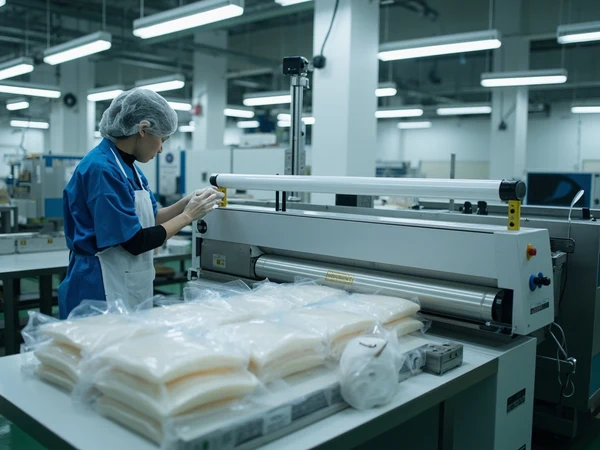
The material of the sealing bands directly affects heat transfer and friction. PTFE-coated bands have a low-friction, low-tacky surface and suit applications where sticking must be avoided; silicone bands offer a more conforming pressure face but a lower temperature ceiling. Bands wear, age and pick up debris during long use, and both heat transfer and friction drift slowly over time, which is why bands need regular cleaning and replacement rather than being kept until they fail.
The thermocouple and the temperature controller are the reference for every qualification. If the displayed temperature differs from the actual sealing jaw temperature, all qualification data is distorted, and such deviation often drifts slowly over time, so it has to be checked periodically by an independent means rather than trusted from the machine's own display.
Cooling is underestimated just as often. If packs are stacked or filled immediately after sealing while the material is still shrinking and setting, the joint can end up looking sealed but actually being a cold or weak weld, and foil structures can deform. Sufficient cooling time and sensible stacking spacing therefore belong inside the window calculation, not outside it.
7. Put the window in the delivery file: parameter guidance and first-article confirmation
For customers running contract or custom packaging, the most useful deliverable is not a statement that the bag is well made, but a parameter guidance sheet that can be used directly on the line: recommended temperature range, pressure range, suggested dwell time, suitable sealing machine types, recommended band material and replacement interval, and the method for judging first articles. With that sheet in hand, a customer whose equipment and material are already fixed can go straight to parameter validation instead of starting from scratch.
First-article confirmation is best run with two methods in parallel: a pull test to judge whether seal strength meets the requirement, and a dye penetration check, where colored liquid is introduced into the seal area and observed for leakage, to judge whether the seal is continuous. Together with the seal strength indicators described above, these two tests let a line judge quickly whether the window sits in the right place.
Baodafor's material experience across ziplock bags, PE cling wrap, aluminum foil and baking paper ultimately has to land in these parameters on the customer's line. Whether a bag is well made is not decided by how it looks as it leaves the factory, but by whether it seals reliably, seals well and stays stable from batch to batch on the customer's machine, inside the customer's window.