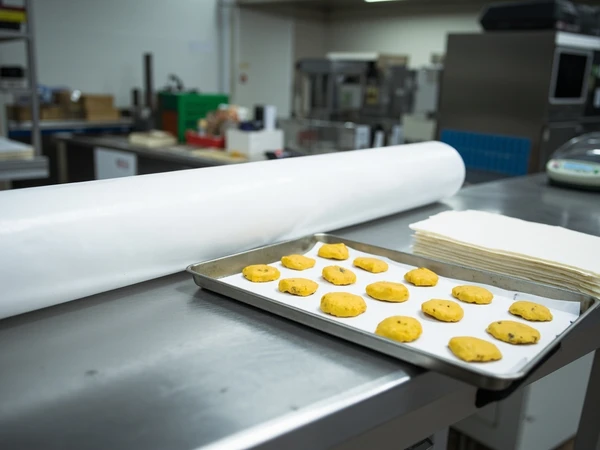
The expansion of chain bakery stores and central kitchens is changing how baking paper gets bought. It used to be treated as a generic consumable, with purchasing decisions based on roll width and unit price. In a chain operation, paper specification now maps directly onto specific baking trays and per-batch output, turning it into a production material configured line by line.
The shift shows up most clearly in three parameters. Grammage: home baking for cakes, biscuits, and cookies works fine at 30 to 40 gsm, while commercial high-heat baking and cases where the paper carries the weight of the bake need 45 gsm and above. Coating configuration decides non-stick performance and whether you must track the coated side; double-coated material can be laid and torn off, single-coated material demands attention to orientation. Width and roll length have to align with the equipment: home ovens commonly run 26×33 cm pans and commercial deck and rack ovens more often 60×40 cm, so sizing a single use at the long edge of the tray plus 5 to 8 cm of trimming allowance on each side is the practical approach.
As demand shifts, supplier service shifts with it. Configuring roll width, grammage, and coating combinations against the customer's tray sizes and output volume is a closer fit than cutting one standard roll for everyone. For volume orders, keeping roughly 10 percent extra in reserve covers reusable silicone mats, pan counts, and batch variation.
Grammage is not simply a case of more is better. Anti-grease performance, structural support, and unit cost have to be balanced, and line-level configuration lets each of those three be optimized separately, which is why a matched specification can cost less overall than a generic roll. For food packaging material manufacturers, competition is moving away from simply supplying material toward delivering a repeatable specification solution.