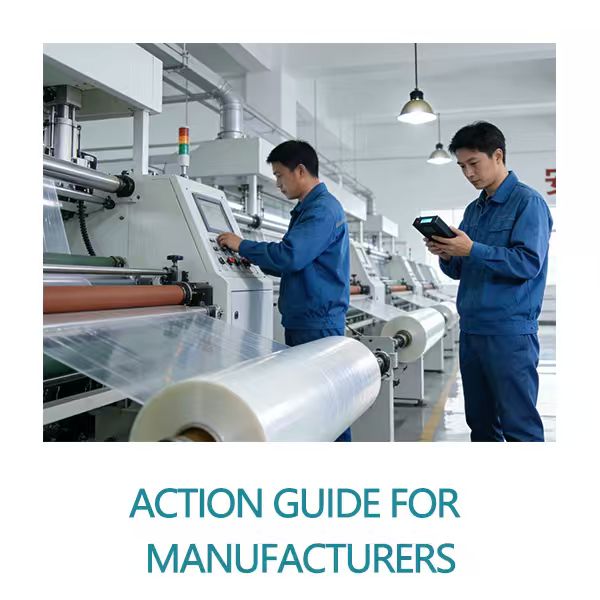
In the food packaging industry, electricity and steam account for a large share of film production cost, and the energy consumed per unit of product directly affects delivery pricing and the strength of supplier relationships. Baodafor has recently launched an upgrade to line-level energy efficiency management at its Xiamen production base, building a unit-consumption monitoring and energy-saving optimization mechanism around the main processes of extrusion, blow molding, and slitting.
The first step is to move energy data from a plant-wide monthly total down to the level of a single process. Previously, the workshop only compiled overall electricity consumption on a monthly basis, which made it difficult to trace where losses actually occurred. Under the new monitoring method, sub-metering devices have been added at key stations such as blow molding units and traction and slitting equipment. The system automatically collects the operating power, downtime, and start-stop cycles of each individual machine by shift, so shift leaders can compare daily unit-consumption figures during handover. Deviations are therefore identified on the same day rather than being rediscovered at month-end reconciliation.
The second step is to connect each deviation with a specific operating practice. Monitoring data showed that frequent start-stop cycles were one of the main reasons unit energy consumption drifted upward. Baodafor accordingly revised its changeover scheduling rules, grouping orders of the same specification together to reduce repeated machine startups, and introduced timed power-off and standby modes for stations that sit idle for long periods, preventing equipment from consuming power while running empty. With film tensile performance and heat-seal strength unchanged, unit electricity consumption per unit of product on the line has declined steadily.
The third step is to institutionalize the gains through assessment and routine training. Unit-consumption indicators have been incorporated into monthly team reviews in the workshop, and energy data interpretation has been added to regular training sessions so that front-line operators understand how process parameters relate to power draw. Energy saving has thereby moved from a periodic campaign to an everyday operating habit.
Viewed over a longer horizon, the returns go beyond the electricity bill. When a line runs within a stable power range, consistency in film thickness and tensile performance is easier to maintain, so quality variation between batches declines. Shorter changeover times also make the fulfillment of small-volume, multi-SKU orders more flexible and dependable.
Baodafor notes that energy efficiency management will be integrated with the existing preventive equipment maintenance system, allowing equipment condition, energy performance, and process parameters to corroborate one another as a single data chain. This supports cost control while delivering more stable and more competitive food packaging supply services to customers.